

CERTIFIED HERS RATER
IN BELMONT, MA
Specialized Opt-In Code compliance, historic renovation modeling, and performance verification for new construction, additions, and gut rehabs.
BUILDING SCIENCE & HERS CHALLENGES IN BELMONT
Building in Belmont requires navigating strict Specialized Opt-In Energy Code pathways alongside tight lot setbacks, historic architectural preservation, and dense residential neighborhoods. From luxury custom tear-downs and all-electric builds on Belmont Hill and Prospect Hill to major additions, two-family gut rehabs, and ADUs near Belmont Center, Cushing Square, Waverley Square, and Winn Brook, local projects demand precision energy modeling before permit submission. Under Belmont's Specialized Code rules, new homes must achieve HERS 45 or lower for all-electric design or HERS 42 or lower for mixed-fuel (which requires mandatory on-site solar PV, electrification pre-wiring, and a strict 4,000 sq. ft. size cap). Meanwhile, expanding older early-20th-century homes triggers combined-structure modeling where existing uninsulated walls and leaky framing can drag down overall scores. Optimizing cold-climate heat pump sizing, compact ductwork, and continuous exterior air sealing early in design ensures projects clear Belmont Office of Community Development plan reviews without mid-construction rework.
(Learn more about how to strategically lower your score on our HERS Rating Optimization in MA guide.)
Core Building Science Factors We Optimize Early:
Specialized Opt-In & 4,000 Sq. Ft. Compliance: Guiding custom teardowns through all-electric design (HERS 45 or lower) or Net Zero (HERS 0) pathways—and verifying solar zone shading and pre-wiring requirements on smaller mixed-fuel builds.
Balancing Additions with Legacy Housing Stock: Mitigating the thermal drag that older, uninsulated 1920s colonials and two-family structures place on new additions under combined-structure HERS 65–70 modeling rules.
Tight-Lot Heat Pump & ERV Integration: Right-sizing quiet, cold-climate heat pumps, compact duct runs, and mandatory continuous ERV/HRV balanced ventilation where space and exterior condenser clearances are tight.
Continuous Exterior Air Barrier Detailing: Specifying durable air sealing across complex rooflines, dormers, rim joists, and stone/concrete foundation transitions to pass mandatory blower door testing in Climate Zone 5A.
In Belmont, HERS compliance isn’t just paperwork, it determines whether your project moves forward, stalls mid-build, or fails at occupancy.
Most project delays happen for three reasons:
FAILED INSPECTIONS DURING CONSTRUCTION
Insulation, air sealing, or HVAC details don’t match the modeled assumptions, forcing costly “open wall” corrections after trades have already left the site.
CERTIFICATE OF OCCUPANCY DELAYS
Your project cannot close without a verified Final HERS Certificate submitted to the building department. Any mismatch between design and field performance can halt occupancy.
MISSED MASS SAVE INCENTIVES
Rebates and financing programs must be locked in early. Waiting until late-stage construction often results in reduced or forfeited incentives due to missed enrollment timing.
THE CORE ISSUE
These problems don’t start in the field, they start when the energy model is not aligned with real construction decisions before permitting.
AVOID COSTLY PERMITTING DELAYS IN BELMONT

AVOID COSTLY PERMITTING DELAYS IN BELMONT
In Belmont, HERS compliance isn’t just paperwork, it determines whether your project moves forward, stalls mid-build, or fails at occupancy.
Most project delays happen for three reasons:
FAILED INSPECTIONS DURING CONSTRUCTION
Insulation, air sealing, or HVAC details don’t match the modeled assumptions, forcing costly “open wall” corrections after trades have already left the site.
CERTIFICATE OF OCCUPANCY DELAYS
Your project cannot close without a verified Final HERS Certificate submitted to the building department. Any mismatch between design and field performance can halt occupancy.
MISSED MASS SAVE INCENTIVES
Rebates and financing programs must be locked in early. Waiting until late-stage construction often results in reduced or forfeited incentives due to missed enrollment timing.
THE CORE ISSUE
These problems don’t start in the field, they start when the energy model is not aligned with real construction decisions before permitting.
START YOUR BELMONT HERS COMPLIANCE REVIEW
Planning a project? Submit your project details and we’ll review your plans, identify your HERS compliance path, and outline what’s required before permitting, so there are no surprises during construction or inspection.
We’ll evaluate your project scope, fuel type, and design assumptions to confirm your target HERS score and highlight any risks that could lead to delays, failed inspections, or unnecessary upgrades.
If plans are available, we’ll review them directly and provide clear, actionable guidance your team can use to stay aligned from design through final testing.


WHEN IS A HERS RATING REQUIRED IN BELMONT?
Belmont has adopted the Massachusetts Specialized Opt-In Energy Code, which requires a performance-based approach to compliance. Identifying these specific triggers early is the most effective way to prevent costly redesigns after framing has already started.
You will need a certified HERS Rater for:
New Construction: All new residential dwellings.
Large Additions: Any addition that exceeds 1,000 sq. ft. or increases the conditioned floor area by more than 100%.
Extensive Renovations: A certified HERS rating is mandatory for the entire dwelling unit if a project meets either of the following "Extensive Alteration" thresholds:
One or Two-Family Homes/Townhouses (IRC): Alterations affecting more than 1,000 sq. ft. or more than 100% of the existing conditioned floor area.
Multifamily Buildings (IEBC): Level 3 Alterations (3 stories or less) affecting more than 1,000 sq. ft. or more than 100% of the existing conditioned floor area.
THE "WHOLE-HOME" RULE: If these thresholds are met, the entire combined dwelling unit (new and existing) must meet HERS targets. We help you balance the design to hit these scores without forcing unnecessary or costly upgrades to the original structure.
THE EXCEPTION: A HERS rating is typically not required when the project consists solely of converting existing unconditioned basement or attic space into conditioned space, provided the move is a result of shifting the home’s thermal boundary.
WHAT OTHERS ARE SAYING
2026 BELMONT
ENERGY CODE REQUIREMENTS
Projects must meet specific HERS Index targets depending on fuel type and project scope. These targets vary based on whether the home is all-electric or mixed-fuel. Meeting these goals requires a whole-home strategy, balancing high-performance enclosures with efficient mechanical systems, particularly in areas like Belmont, where large homes and complex mechanical systems increase the importance of early design alignment.
Mixed Fuel
Building
New Construction
HERS 42
New Construction Embodied Carbon Credit
HERS 45
Accessory Dwelling Unit
HERS 52
Major Alterations, Renovations,
Change of Use
HERS 65
Solar Electric
Generation
New Construction
HERS 42
New Construction Embodied Carbon Credit
HERS 45
Accessory Dwelling Unit
HERS 55
Major Alterations, Renovations,
Change of Use
HERS 70
All-Electric
Building
New Construction
HERS 45
New Construction Embodied Carbon Credit
HERS 48
Accessory Dwelling Unit
HERS 55
Major Alterations, Renovations,
Change of Use
HERS 70
Solar Electric &
All-Electric Building
New Construction
HERS 45
New Construction Embodied Carbon Credit
HERS 48
Accessory Dwelling Unit
HERS 58
Major Alterations, Renovations,
Change of Use
HERS 75

NAVIGATING COMPLIANCE: HOW WE WORK WITH THE BELMONT BUILDING DEPARTMENT
To pull a building permit under the Massachusetts Specialized Opt-In Code in Belmont, you must submit an Initial HERS Design Certificate alongside your architectural plans. Before your final Certificate of Occupancy (CO) is granted, your project must pass mandatory on-site field verifications to prove the home meets modeled efficiency targets.
We follow a Modeled → Verified → Certified workflow to manage local compliance and lock in Mass Save® incentives:
Phase 1: Pre-Permit Design Modeling
We analyze your architectural drawings to issue your official Initial HERS Design Certificate for plan review. Early modeling confirms your HERS target and prevents mid-project redesigns or costly HVAC changes after construction starts.
Phase 2: Mid-Stage Rough-In Verification
We conduct on-site thermal bypass and duct leakage inspections while walls are still open. Verifying air barrier continuity and insulation details early ensures as-built conditions match the model before drywall closes up critical assemblies.
Phase 3: Final Testing & CO Certification
We perform final blower door testing, duct blaster testing, and mechanical ventilation verification. Once verified, we issue the final Certified HERS Certificate required by Belmont building officials for Certificate of Occupancy sign-off.
OUR HERS SERVICES
We provide the full suite of energy modeling and diagnostic testing required for Massachusetts residential code compliance and performance verification.
RESNET Certified HERS Rating: Performance-based compliance required for new construction and major renovation projects in Belmont.
Energy Modeling (Ekotrope): Pre-construction analysis used to predict energy performance and confirm Stretch Code compliance before building begins.
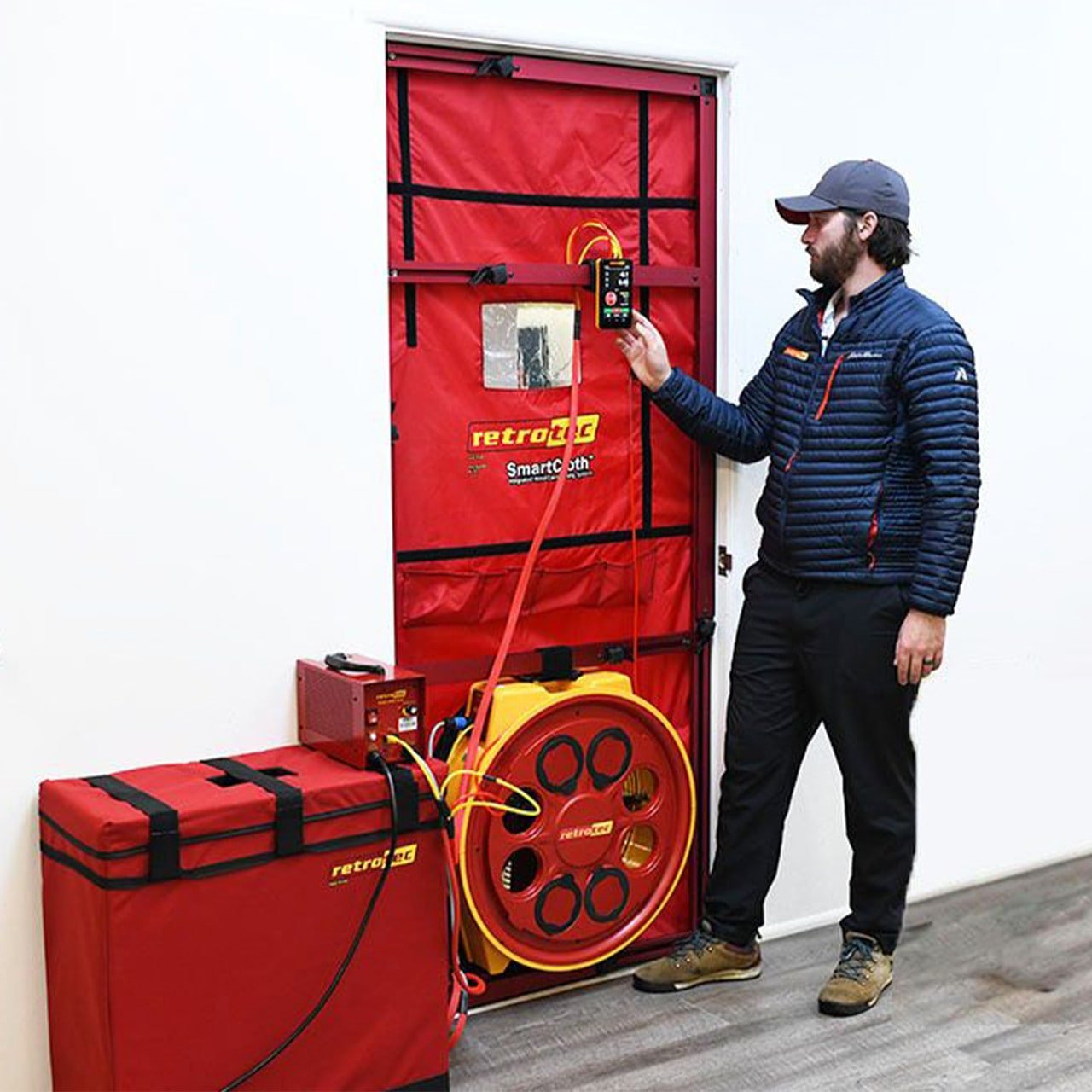
Blower Door Testing: Envelope testing to measure airtightness, identify air leakage, and verify performance during inspection phases.
Duct Leakage Testing: HVAC system testing to confirm distribution efficiency and ensure conditioned air reaches the intended spaces.
Mechanical Ventilation Testing: Airflow verification for HRVs and ERVs to ensure proper indoor air quality and code-compliant ventilation rates.
OUR HERS SERVICES
We provide the full suite of energy modeling and diagnostic testing required for Massachusetts residential code compliance and performance verification.
RESNET Certified HERS Rating: Performance-based compliance required for new construction and major renovation projects in Belmont.
Energy Modeling (Ekotrope): Pre-construction analysis used to predict energy performance and confirm Stretch Code compliance before building begins.
Blower Door Testing: Envelope testing to measure airtightness, identify air leakage, and verify performance during inspection phases.
Duct Leakage Testing: HVAC system testing to confirm distribution efficiency and ensure conditioned air reaches the intended spaces.
Mechanical Ventilation Testing: Airflow verification for HRVs and ERVs to ensure proper indoor air quality and code-compliant ventilation rates.

WHY BELMONT PARTNERS WITH SPECTRUM ENERGY
Belmont projects don’t fail because of bad construction, they fail because HERS compliance is not aligned with real building decisions early enough.
Spectrum Energy combines energy modeling, field verification, and real construction experience to ensure your design meets code the first time.
Before becoming a HERS Rater, I owned an insulation company and worked on 1,500+ homes across Eastern Massachusetts, giving me direct insight into how buildings actually perform once constructed, not just how they are modeled.
That experience helps prevent the issues that most often lead to delays and failed inspections:
Air sealing and insulation mismatches
Mid-project HVAC design changes
Disconnects between modeled assumptions and field conditions
Certificate of Occupancy delays
The result is a process that stays aligned from design through certification, reducing surprises during construction and keeping projects on schedule.
MAXIMIZE UTILITY & STATE INCENTIVES IN BELMONT
Because Belmont’s electricity is provided by Belmont Light rather than an investor-owned utility, Belmont projects do not participate in standard Mass Save electric rebates. Instead, we help Belmont builders and homeowners navigate the local municipal and state incentives specifically available to Municipal Light Plant (MLP) communities:
Belmont Light Electrification Rebates: $1,000 per ton for cold-climate air source heat pumps, $750 for ENERGY STAR heat pump water heaters, and $500 for induction ranges.
State MLP Financing & Accelerators: Access to programs built specifically for non-Mass Save electric towns, including the MA DOER MLP Z-Loan (0% interest financing) and New England Heat Pump Accelerator (NEHPA) incentives.
Weatherization & Gas Utility Stacking: For existing homes undergoing major additions or renovations, we coordinate Belmont Light weatherization rebates alongside National Grid gas Mass Save incentives where applicable.
By aligning your HERS energy model and equipment specs with Belmont Light’s technical guidelines early in design, you lock in maximum rebates while meeting Specialized Opt-In code requirements.

MAXIMIZE UTILITY & STATE INCENTIVES IN BELMONT
Because Belmont’s electricity is provided by Belmont Light rather than an investor-owned utility, Belmont projects do not participate in standard Mass Save electric rebates. Instead, we help Belmont builders and homeowners navigate the local municipal and state incentives specifically available to Municipal Light Plant (MLP) communities:
Belmont Light Electrification Rebates: $1,000 per ton for cold-climate air source heat pumps, $750 for ENERGY STAR heat pump water heaters, and $500 for induction ranges.
State MLP Financing & Accelerators: Access to programs built specifically for non-Mass Save electric towns, including the MA DOER MLP Z-Loan (0% interest financing) and New England Heat Pump Accelerator (NEHPA) incentives.
Weatherization & Gas Utility Stacking: For existing homes undergoing major additions or renovations, we coordinate Belmont Light weatherization rebates alongside National Grid gas Mass Save incentives where applicable.
By aligning your HERS energy model and equipment specs with Belmont Light’s technical guidelines early in design, you lock in maximum rebates while meeting Specialized Opt-In code requirements.
ACE YOUR HERS RATING IN BELMONT
Planning a new home, major renovation, or addition in Belmont, MA? Our HERS Rating Guide gives you the insider strategies to confidently meet Specialized Opt-In Code while building a high-performance, energy-efficient home.
Inside the guide, you’ll learn how to:
Optimize your building envelope – walls, roof, floors, and air sealing and insulation
Use energy-smart systems and appliances – HVAC, lighting, and water heating
Select efficient windows and doors – reduce energy loss and improve comfort
Ensure balanced ventilation – ERVs for indoor air quality
Sign up today to receive your copy of our comprehensive Belmont HERS Rating Guide and get the tools you need to ace your HERS Rating from day one.


RELATED RESOURCES
Looking for more information on 2026 compliance? Explore our regional resources or see how we support projects in our neighboring communities:
Middlesex County HERS Ratings and Compliance Hub – Our centralized resource for MetroWest energy standards.
Master Guide to the 2026 Massachusetts Energy Code – A comprehensive breakdown of the latest Stretch and Specialized Code requirements.
Service Area: We also provide certified HERS ratings and diagnostic testing in Lexington, Cambridge, Concord, and beyond.
FAQs - BELMONT, MA
-
Because Belmont is served by Belmont Light rather than an investor-owned utility, local interconnection rules, municipal rebates, and net metering policies differ from neighboring towns. If you are pursuing a mixed-fuel build in Belmont that triggers the Specialized Code's mandatory solar PV requirement (unless roof shading exceeds 70% or the solar zone is under 300 sq. ft.), or if you are designing an all-electric heat pump home, we coordinate your HERS energy model with Belmont Light's technical guidelines early so there are no surprises during permitting or interconnection.
-
This is one of the most common hurdles in Belmont when expanding older colonials, capes, or two-family homes near Belmont Center, Cushing Square, or Waverley. Because the existing structure is modeled alongside the new addition, uninsulated exterior walls, leaky attic knee walls, or aging ductwork in the original house can pull down the combined HERS score. We provide a pre-permit 'Roadmap to Compliance' that pinpoints the highest-ROI air sealing, attic insulation, or heat pump upgrades in the existing home so you pass HERS 65–70 without overbuilding.
-
Under Massachusetts Stretch Code rules enforced in Belmont (additions and renovations follow standard Stretch Code rules rather than Specialized new-construction rules), a certified HERS rating is required when a residential project meets either of the following triggers:
Large Additions: Any addition adding more than 1,000 sq. ft. of conditioned space or increasing the existing conditioned floor area by more than 100%.
Extensive Alterations: Level 3 renovations impacting more than 1,000 sq. ft. or 100% of the existing conditioned floor area.
When triggered, the entire combined dwelling unit—both the existing structure and new addition—is modeled together under a relaxed target of HERS 65–70. Identifying this trigger during schematic design prevents costly framing and insulation redesigns.
-
Belmont enforces the Massachusetts Specialized Opt-In Energy Code, which establishes Net Zero pathways for new residential builds. For new homes under 4,000 sq. ft., builders may choose between an all-electric pathway (HERS 45 or lower) or a mixed-fuel pathway (HERS 42 or lower, plus mandatory on-site solar PV and full pre-wiring for future electrification). However, for new homes exceeding 4,000 sq. ft. in Belmont, mixed-fuel builds must achieve a Net Zero HERS 0 rating—making all-electric heat pump design the standard compliance path for larger custom homes. Early energy modeling ensures your plans clear Belmont building inspection review smoothly.
This page is part of the Spectrum Energy Massachusetts HERS Rating network, providing specialized compliance coverage across Essex County, Middlesex County, Norfolk County, and Suffolk County.