

CERTIFIED HERS RATER
IN BOSTON, MA
Specialized Opt-In Code compliance and performance verification for new construction, renovations and additions.
BUILDING SCIENCE & HERS CHALLENGES IN BOSTON
Building in Boston requires balancing strict modern energy compliance with extreme structural density and historic urban architecture. From historic brownstone gut rehabs and masonry row houses in Back Bay, Beacon Hill, and the South End to dense triple-decker renovations and urban infill projects across South Boston, Dorchester, Jamaica Plain, and East Boston, local building enclosures present unique performance hurdles. Under Boston's Specialized Opt-In Code, achieving passing HERS scores demands optimizing heat pump layouts, low-COP water heating strategies, and electric-ready infrastructure early in design—while ensuring continuous air sealing holds up across shared party walls and historic masonry assemblies during mandatory blower door testing.
Core Building Science Factors We Optimize Early:
HVAC & Heat Pump Selection: Sizing high-efficiency heat pumps, ductwork layouts, and mechanical ventilation (ERVs/HRVs) for optimal HERS modeling performance in Climate Zone 5A.
Water Heating Efficiency: Specifying high-COP heat pump water heaters to significantly lower overall energy loads and boost target HERS scores.
Thermal Assembly & Enclosure R-Values: Balancing continuous exterior insulation, wall assemblies, and high-performance coastal window specs ($U$-factors and SHGC) to lock in baseline efficiency.
Air Barrier Continuity: Detailing continuous air sealing across complex roof-to-wall transitions, floor cantilevers, rim joists, and foundations to ensure the home passes its mandatory blower door test.
In Boston, HERS compliance isn’t just paperwork, it determines whether your project moves forward, stalls mid-build, or fails at occupancy.
Most project delays happen for three reasons:
FAILED INSPECTIONS DURING CONSTRUCTION
Insulation, air sealing, or HVAC details don’t match the modeled assumptions, forcing costly “open wall” corrections after trades have already left the site.
CERTIFICATE OF OCCUPANCY DELAYS
Your project cannot close without a verified Final HERS Certificate submitted to the building department. Any mismatch between design and field performance can halt occupancy.
MISSED MASS SAVE INCENTIVES
Rebates and financing programs must be locked in early. Waiting until late-stage construction often results in reduced or forfeited incentives due to missed enrollment timing.
THE CORE ISSUE
These problems don’t start in the field, they start when the energy model is not aligned with real construction decisions before permitting.
AVOID COSTLY PERMITTING DELAYS IN BOSTON

AVOID COSTLY PERMITTING DELAYS IN BOSTON
In Boston, HERS compliance isn’t just paperwork, it determines whether your project moves forward, stalls mid-build, or fails at occupancy.
Most project delays happen for three reasons:
FAILED INSPECTIONS DURING CONSTRUCTION
Insulation, air sealing, or HVAC details don’t match the modeled assumptions, forcing costly “open wall” corrections after trades have already left the site.
CERTIFICATE OF OCCUPANCY DELAYS
Your project cannot close without a verified Final HERS Certificate submitted to the building department. Any mismatch between design and field performance can halt occupancy.
MISSED MASS SAVE INCENTIVES
Rebates and financing programs must be locked in early. Waiting until late-stage construction often results in reduced or forfeited incentives due to missed enrollment timing.
THE CORE ISSUE
These problems don’t start in the field, they start when the energy model is not aligned with real construction decisions before permitting.
START YOUR BOSTON HERS COMPLIANCE REVIEW
Planning a project? Submit your project details and we’ll review your plans, identify your HERS compliance path, and outline what’s required before permitting, so there are no surprises during construction or inspection.
We’ll evaluate your project scope, fuel type, and design assumptions to confirm your target HERS score and highlight any risks that could lead to delays, failed inspections, or unnecessary upgrades.
If plans are available, we’ll review them directly and provide clear, actionable guidance your team can use to stay aligned from design through final testing.


WHEN IS A HERS RATING REQUIRED IN BOSTON?
Boston has adopted the Massachusetts Specialized Opt-In Energy Code, which requires a performance-based approach to compliance. Identifying these specific triggers early is the most effective way to prevent costly redesigns after framing has already started.
You will need a certified HERS Rater for:
New Construction: All new residential dwellings.
Large Additions: Any addition that exceeds 1,000 sq. ft. or increases the conditioned floor area by more than 100%.
Extensive Renovations: A certified HERS rating is mandatory for the entire dwelling unit if a project meets either of the following "Extensive Alteration" thresholds:
One or Two-Family Homes/Townhouses (IRC): Alterations affecting more than 1,000 sq. ft. or more than 100% of the existing conditioned floor area.
Multifamily Buildings (IEBC): Level 3 Alterations (3 stories or less) affecting more than 1,000 sq. ft. or more than 100% of the existing conditioned floor area.
THE "WHOLE-HOME" RULE: If these thresholds are met, the entire combined dwelling unit (new and existing) must meet HERS targets. We help you balance the design to hit these scores without forcing unnecessary or costly upgrades to the original structure.
THE EXCEPTION: A HERS rating is typically not required when the project consists solely of converting existing unconditioned basement or attic space into conditioned space, provided the move is a result of shifting the home’s thermal boundary.
WHAT OTHERS ARE SAYING
2026 BOSTON
ENERGY CODE REQUIREMENTS
Projects must meet specific HERS Index targets depending on fuel type and project scope. These targets vary based on whether the home is all-electric or mixed-fuel. Meeting these goals requires a whole-home strategy, balancing high-performance enclosures with efficient mechanical systems, particularly in Boston, where dense construction, electrification, and multifamily design significantly influence compliance strategy.
Mixed Fuel
Building
New Construction
HERS 42
New Construction Embodied Carbon Credit
HERS 45
Accessory Dwelling Unit
HERS 52
Major Alterations, Renovations,
Change of Use
HERS 65
Solar Electric
Generation
New Construction
HERS 42
New Construction Embodied Carbon Credit
HERS 45
Accessory Dwelling Unit
HERS 55
Major Alterations, Renovations,
Change of Use
HERS 70
All-Electric
Building
New Construction
HERS 45
New Construction Embodied Carbon Credit
HERS 48
Accessory Dwelling Unit
HERS 55
Major Alterations, Renovations,
Change of Use
HERS 70
Solar Electric &
All-Electric Building
New Construction
HERS 45
New Construction Embodied Carbon Credit
HERS 48
Accessory Dwelling Unit
HERS 58
Major Alterations, Renovations,
Change of Use
HERS 75

NAVIGATING COMPLIANCE: HOW WE WORK WITH THE BOSTON BUILDING DEPARTMENT
To pull a building permit under the Massachusetts Specialized Opt-In Code in Boston, you must submit an Initial HERS Design Certificate alongside your architectural plans. Before your final Certificate of Occupancy (CO) is granted, your project must pass mandatory on-site field verifications to prove the home meets modeled efficiency targets.
We follow a Modeled → Verified → Certified workflow to manage local compliance and lock in Mass Save® incentives:
Phase 1: Pre-Permit Design Modeling
We analyze your architectural drawings to issue your official Initial HERS Design Certificate for plan review. Early modeling confirms your HERS target and prevents mid-project redesigns or costly HVAC changes after construction starts.
Phase 2: Mid-Stage Rough-In Verification
We conduct on-site thermal bypass and duct leakage inspections while walls are still open. Verifying air barrier continuity and insulation details early ensures as-built conditions match the model before drywall closes up critical assemblies.
Phase 3: Final Testing & CO Certification
We perform final blower door testing, duct blaster testing, and mechanical ventilation verification. Once verified, we issue the final Certified HERS Certificate required by Boston building officials for Certificate of Occupancy sign-off.
OUR HERS SERVICES
We provide the full suite of energy modeling and diagnostic testing required for Massachusetts residential code compliance and performance verification.
RESNET Certified HERS Rating: Performance-based compliance required for new construction and major renovation projects in Boston.
Energy Modeling (Ekotrope): Pre-construction analysis used to predict energy performance and confirm Stretch Code compliance before building begins.
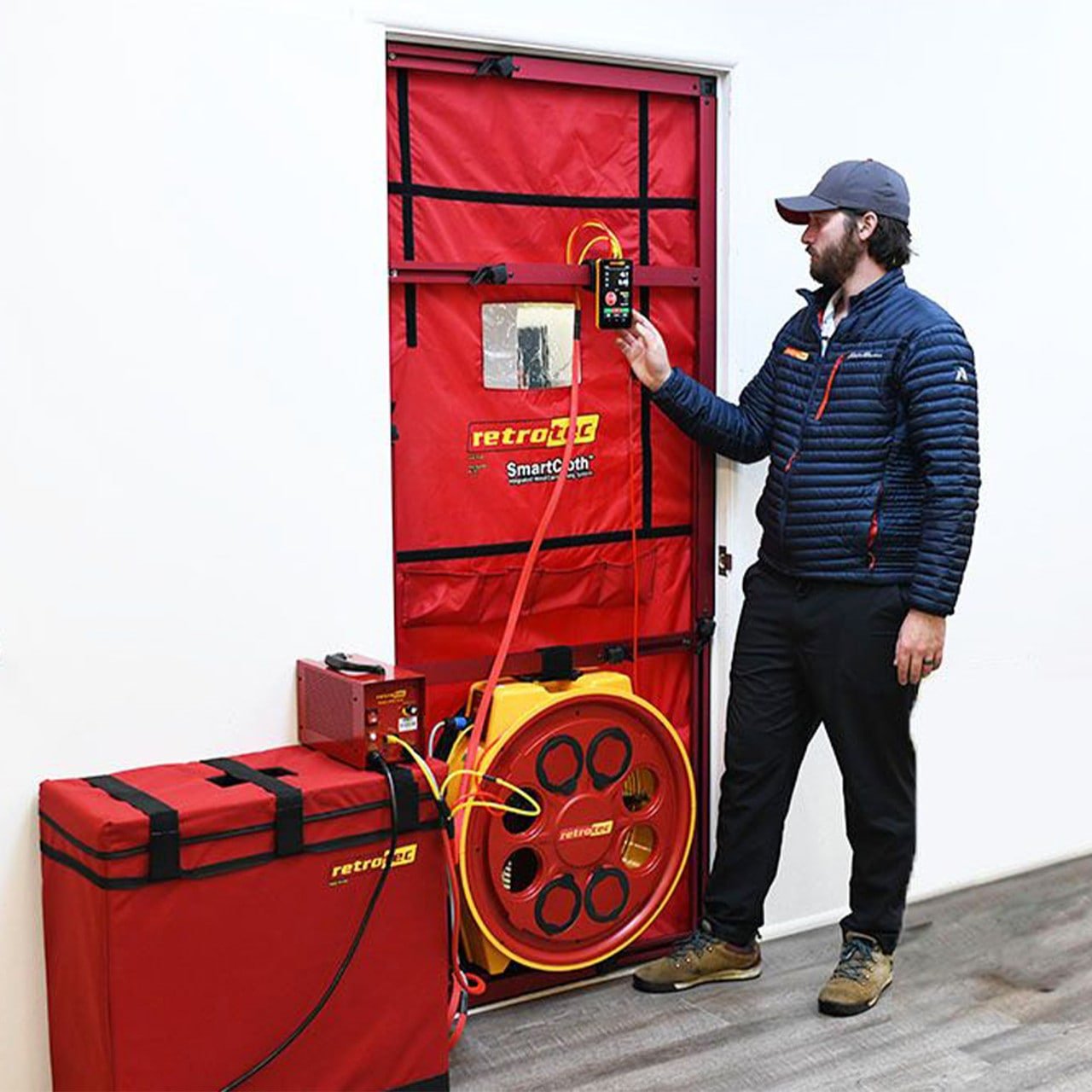
Blower Door Testing: Envelope testing to measure airtightness, identify air leakage, and verify performance during inspection phases.
Duct Leakage Testing: HVAC system testing to confirm distribution efficiency and ensure conditioned air reaches the intended spaces.
Mechanical Ventilation Testing: Airflow verification for HRVs and ERVs to ensure proper indoor air quality and code-compliant ventilation rates.
OUR HERS SERVICES
We provide the full suite of energy modeling and diagnostic testing required for Massachusetts residential code compliance and performance verification.
RESNET Certified HERS Rating: Performance-based compliance required for new construction and major renovation projects in Boston.
Energy Modeling (Ekotrope): Pre-construction analysis used to predict energy performance and confirm Stretch Code compliance before building begins.
Blower Door Testing: Envelope testing to measure airtightness, identify air leakage, and verify performance during inspection phases.
Duct Leakage Testing: HVAC system testing to confirm distribution efficiency and ensure conditioned air reaches the intended spaces.
Mechanical Ventilation Testing: Airflow verification for HRVs and ERVs to ensure proper indoor air quality and code-compliant ventilation rates.

WHY BOSTON PARTNERS WITH SPECTRUM ENERGY
Boston projects don’t fail because of bad construction, they fail because HERS compliance is not aligned with real building decisions early enough.
Spectrum Energy combines energy modeling, field verification, and real construction experience to ensure your design meets code the first time.
Before becoming a HERS Rater, I owned an insulation company and worked on 1,500+ homes across Eastern Massachusetts, giving me direct insight into how buildings actually perform once constructed, not just how they are modeled.
That experience helps prevent the issues that most often lead to delays and failed inspections:
Air sealing and insulation mismatches
Mid-project HVAC design changes
Disconnects between modeled assumptions and field conditions
Certificate of Occupancy delays
The result is a process that stays aligned from design through certification, reducing surprises during construction and keeping projects on schedule.
SAVE THOUSANDS WITH INCENTIVES
New Construction (All-Electric)
Projects may qualify for $7,500–$25,000 in incentives depending on final HERS performance and program tier (Base, ENERGY STAR®, Passive House pathways).
Renovations & Additions
Large-scale projects (including Level 3 alterations) may qualify for up to $30,000 when transitioning to high-performance or all-electric systems.
0% HEAT Loan Financing
Eligible projects may access up to $25,000 in 0% interest financing for approved energy-efficiency upgrades.
OUR ROLE
Mass Save® incentives are not guaranteed by permitting alone. Qualification depends on verified modeling and field performance.
We provide the energy modeling, documentation, and testing required to help ensure your project is properly positioned to maximize available incentives and avoid leaving eligible funding on the table.

SAVE THOUSANDS WITH INCENTIVES
New Construction (All-Electric)
Projects may qualify for $7,500–$25,000 in incentives depending on final HERS performance and program tier (Base, ENERGY STAR®, Passive House pathways).
Renovations & Additions
Large-scale projects (including Level 3 alterations) may qualify for up to $30,000 when transitioning to high-performance or all-electric systems.
0% HEAT Loan Financing
Eligible projects may access up to $25,000 in 0% interest financing for approved energy-efficiency upgrades.
OUR ROLE
Mass Save® incentives are not guaranteed by permitting alone. Qualification depends on verified modeling and field performance.
We provide the energy modeling, documentation, and testing required to help ensure your project is properly positioned to maximize available incentives and avoid leaving eligible funding on the table.
ACE YOUR HERS RATING IN BOSTON
Planning a new home, major renovation, or addition in Boston, MA? Our HERS Rating Guide gives you the insider strategies to confidently meet Specialized Opt-In Code while building a high-performance, energy-efficient home.
Inside the guide, you’ll learn how to:
Optimize your building envelope – walls, roof, floors, and air sealing and insulation
Use energy-smart systems and appliances – HVAC, lighting, and water heating
Select efficient windows and doors – reduce energy loss and improve comfort
Ensure balanced ventilation – ERVs for indoor air quality
Sign up today to receive your copy of our comprehensive Boston HERS Rating Guide and get the tools you need to ace your HERS Rating from day one.


RELATED RESOURCES
Looking for more information on 2026 compliance? Explore our regional resources or see how we support projects in our neighboring communities:
Suffolk County HERS Ratings and Compliance Hub – Our centralized resource for Greater Boston energy standards.
Master Guide to the 2026 Massachusetts Energy Code – A comprehensive breakdown of the latest Stretch and Specialized Code requirements.
Service Area: We also provide certified HERS ratings and diagnostic testing in Lexington, Cambridge, Concord, and beyond.
FAQs - BOSTON, MA
-
As early as possible, ideally during the design phase.
A Preliminary HERS Rating is required for permitting
Early modeling helps avoid redesigns and failed inspections
Mass Save programs typically require enrollment before framing begins
The Bottom Line: Early involvement is the only way to guarantee your project qualifies for the performance-based incentive checks and meets all 2026 code thresholds.
-
This is common in Boston during major renovations of historic brick row houses or triple-deckers. When a project triggers code compliance, modeling an old uninsulated structure alongside a new addition or rehab can drag down the score. We provide a pre-permit 'Roadmap to Compliance' that targets strategic interior air sealing and insulation upgrades without compromising historic street-facing facades.
-
Under the Massachusetts Specialized Opt-In Code enforced in Boston, a certified HERS rating is required when a residential project meets either of the following thresholds:
Large Additions: Any addition that adds over 1,000 sq. ft. of conditioned space or increases the existing conditioned floor area by more than 100%.
Extensive Alterations: Renovations or alterations impacting more than 1,000 sq. ft. or 100% of the existing conditioned floor area (Level 3 Alteration).
If triggered, the entire combined dwelling unit—both the existing structure and new addition—must be modeled and certified to meet target HERS scores. Identifying this trigger during early design is the single most effective way to avoid costly redesigns after framing has already started.
-
The Specialized Opt-In Code applies exclusively to new construction. For new builds, it requires meeting net-zero pathways—meaning mixed-fuel homes must include electric-ready pre-wiring and dedicated solar PV, while all-electric builds provide the simplest, most direct path to compliance.
If your project is an addition or renovation, the Specialized Code does not apply; your project simply follows standard Stretch Code rules (HERS targets based on scope, with no mandatory solar PV requirements). We model both scenarios early so you hit permit approval with Boston Inspectional Services (ISD) without over-engineering your design.

FAQs - BOSTON, MA
-
As early as possible, ideally during the design phase.
A Preliminary HERS Rating is required for permitting
Early modeling helps avoid redesigns and failed inspections
Mass Save programs typically require enrollment before framing begins
The Bottom Line: Early involvement is the only way to guarantee your project qualifies for the performance-based incentive checks and meets all 2026 code thresholds.
-
This is common in Boston during major renovations of historic brick row houses or triple-deckers. When a project triggers code compliance, modeling an old uninsulated structure alongside a new addition or rehab can drag down the score. We provide a pre-permit 'Roadmap to Compliance' that targets strategic interior air sealing and insulation upgrades without compromising historic street-facing facades.
-
Under the Massachusetts Specialized Opt-In Code enforced in Boston, a certified HERS rating is required when a residential project meets either of the following thresholds:
Large Additions: Any addition that adds over 1,000 sq. ft. of conditioned space or increases the existing conditioned floor area by more than 100%.
Extensive Alterations: Renovations or alterations impacting more than 1,000 sq. ft. or 100% of the existing conditioned floor area (Level 3 Alteration).
If triggered, the entire combined dwelling unit—both the existing structure and new addition—must be modeled and certified to meet target HERS scores. Identifying this trigger during early design is the single most effective way to avoid costly redesigns after framing has already started.
-
The Specialized Opt-In Code applies exclusively to new construction. For new builds, it requires meeting net-zero pathways—meaning mixed-fuel homes must include electric-ready pre-wiring and dedicated solar PV, while all-electric builds provide the simplest, most direct path to compliance.
If your project is an addition or renovation, the Specialized Code does not apply; your project simply follows standard Stretch Code rules (HERS targets based on scope, with no mandatory solar PV requirements). We model both scenarios early so you hit permit approval with Boston Inspectional Services (ISD) without over-engineering your design.
This page is part of the Spectrum Energy Massachusetts HERS Rating network, providing specialized compliance coverage across Essex County, Middlesex County, Norfolk County, and Suffolk County.