For new construction in Massachusetts communities using the Stretch or Specialized Opt-In Energy Code, qualifying low-carbon concrete can provide an additional compliance allowance that builders may overlook.
Under Section R406.5.2 of the Massachusetts residential energy code, eligible new construction can use a low-global-warming-potential (GWP) concrete credit to increase the maximum allowable HERS rating by 3 points per applicable dwelling unit.
For a project close to its required HERS limit, that allowance may provide useful flexibility. But the concrete must meet the applicable emissions thresholds, and the project team must document compliance using the required Environmental Product Declarations (EPDs) and calculations.
The important distinction is that this credit raises the maximum allowable HERS rating. It does not automatically improve the home's modeled HERS score by three points.
What Does the Low-GWP Concrete Credit Require?
Section R406.5.2 allows eligible new single-family dwelling units and residential buildings containing multiple dwelling units to use the concrete credit when at least 90% of the concrete mix used in the building meets the applicable GWP criteria.
The thresholds are based on the 2022 National Ready Mixed Concrete Association (NRMCA) Northeast regional benchmark. The maximum allowable GWP varies according to the concrete's specified compressive strength and whether it is normal-weight or lightweight concrete.
Maximum GWP limits for qualifying concrete
The following limits are listed in Table R406.5.4 of the Massachusetts residential Stretch and Specialized Code.
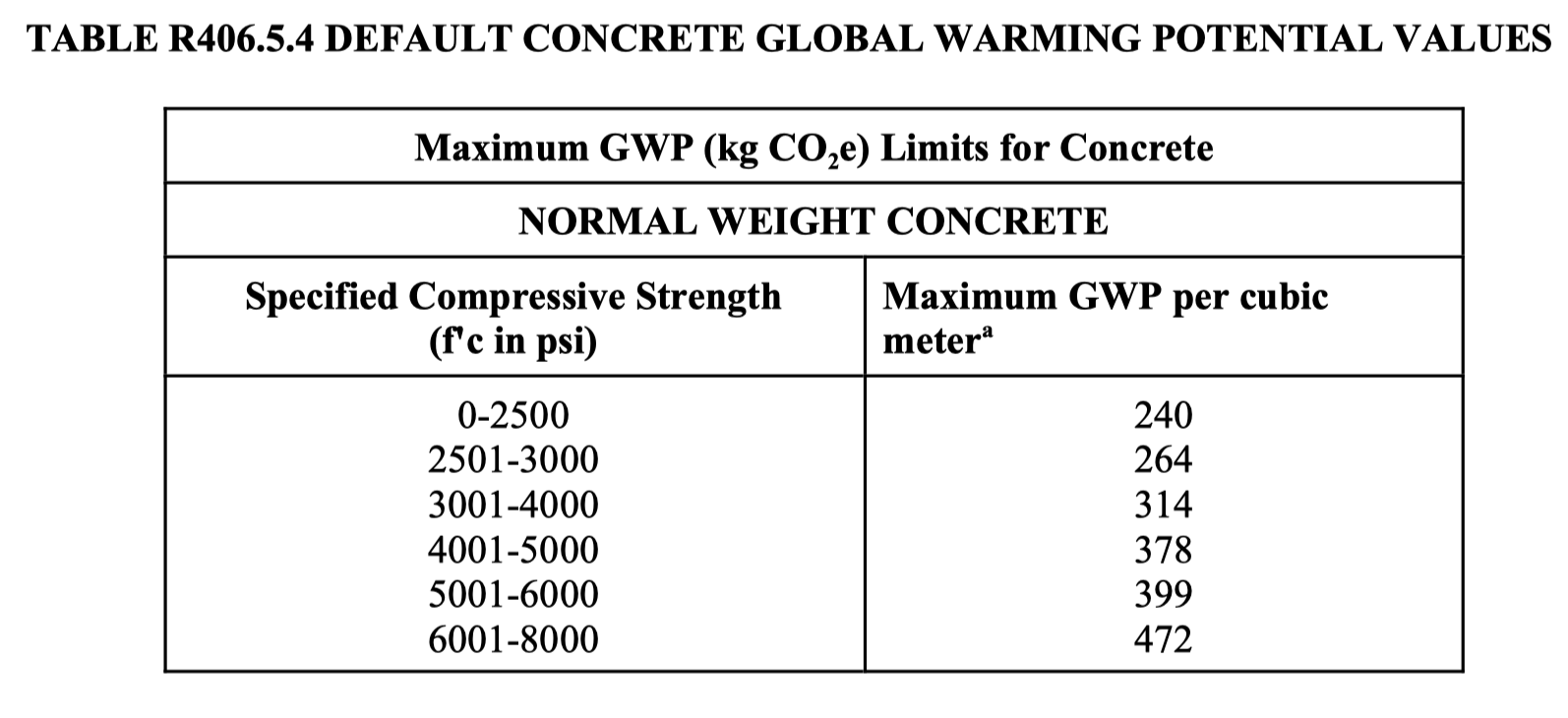
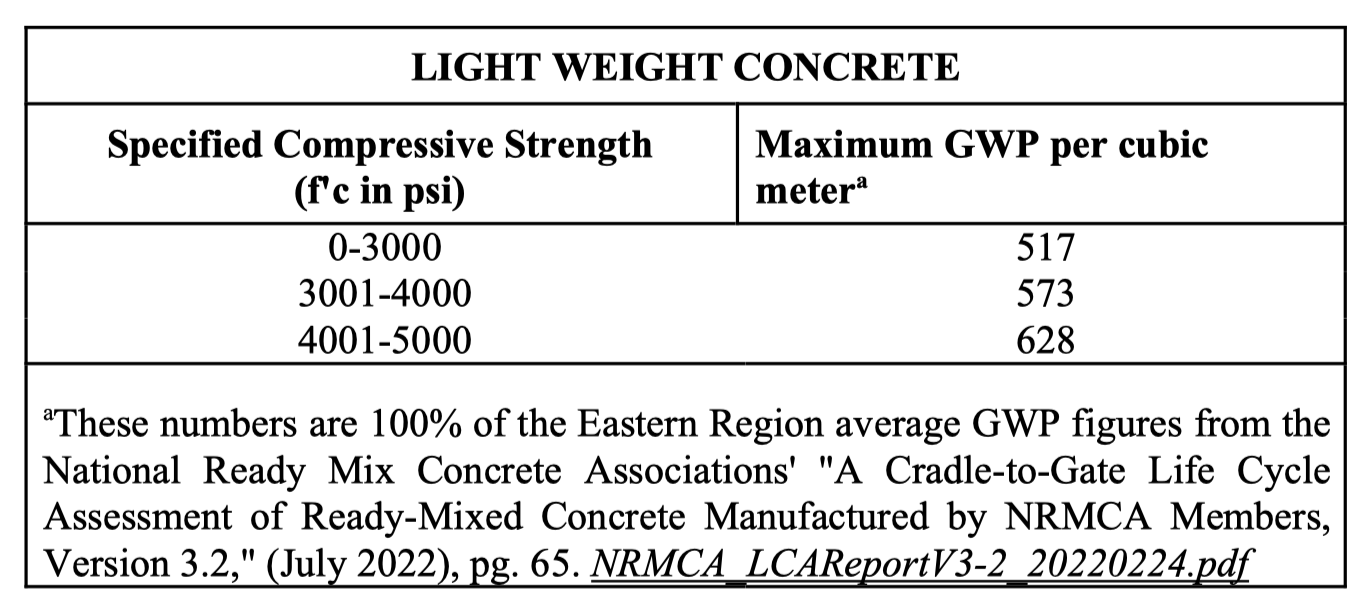
These values are important because not every mix marketed as lower-carbon concrete will automatically qualify. The mix's documented GWP must be compared with the applicable limit for its strength and weight classification.
What Documentation Does the HERS Rater Need?
The credit requires more than a general statement that a project uses environmentally preferable concrete.
Under Section R406.5.4, the HERS rater must submit specific EPDs for the concrete used in the dwelling unit or building. When multiple concrete mixes are used, the project must also provide a calculation summarizing estimated embodied-carbon emissions for at least 90% of the concrete materials used.
The documentation process should include:
Mix-specific EPDs: Obtain the environmental documentation for the actual concrete mixes supplied to the project.
Ready-mix supplier verification: The EPDs must be verified by the concrete ready-mix provider.
GWP values: Confirm the reported GWP per cubic meter of concrete as supplied.
Mix quantities and classifications: Track the concrete mixes, quantities, specified strengths, and applicable classifications needed to evaluate compliance.
A project-level calculation: Where multiple mixes are used, assemble the required calculation demonstrating that the applicable GWP limits are met for at least 90% of the concrete used.
The HERS rater needs this information to substantiate the credit. It is much easier to collect the documentation during design and construction than to reconstruct the concrete schedule after the foundation and other concrete work have been completed.
When Should the Builder Contact the Concrete Supplier?
The best time is during design and before ordering concrete.
Foundation plans and structural specifications often establish the concrete strength and intended applications well before a pour is scheduled. That gives the builder and design team an opportunity to ask whether a qualifying mix is available for each application.
A practical sequence is:
Confirm the project's code pathway and HERS limit. Establish whether the new dwelling unit is subject to the applicable R406 requirements.
Identify the concrete applications. Review the foundation, footings, slab, and other concrete work included in the project.
Contact the ready-mix supplier. Ask about mixes that meet the applicable GWP limits while satisfying the project's structural and construction requirements.
Request EPDs and track quantities. Obtain the required documentation and maintain records of the mixes supplied.
Coordinate with the HERS rater. Confirm what information and calculations will be needed to document the credit.
For Massachusetts projects, the MassCEC Find Lower-Carbon Concrete resource is a useful starting point. It identifies ready-mix suppliers with published lower-carbon mixes and explains how project teams can explore available options.
Availability, pricing, mix suitability, and lead times should be confirmed directly with the supplier.
How Much Difference Can Three HERS Points Make?
The allowance can matter when a project is close to its maximum permitted HERS rating.
For example, under the applicable new-construction table, an all-electric dwelling with a maximum allowable HERS rating of 45 could have a maximum of 48 when an eligible embodied-carbon credit is applied. A mixed-fuel dwelling with a maximum of 42 could have a maximum of 45.
These examples illustrate the change in the allowable limit, not a change in the home's actual modeled score.
The distinction matters. A project must still be modeled and verified under the applicable code requirements. The concrete credit is one compliance option—not a replacement for appropriate envelope design, HVAC efficiency, water-heating performance, air sealing, or ventilation.
Section R406.5.2 also provides a separate embodied-carbon option for insulation. The concrete credit should be evaluated under its own documentation requirements, and the project team should confirm the applicable rules before selecting a compliance strategy.
The Takeaway for Builders and Architects
Low-carbon concrete is worth considering early in the design of new residential construction subject to Massachusetts Stretch or Specialized Opt-In Code requirements.
The potential benefit is twofold: the project can reduce the embodied carbon associated with its concrete, and qualifying concrete can provide a three-point increase in the maximum allowable HERS rating for each applicable dwelling unit.
The key is coordination. The builder, architect, structural designer, concrete supplier, and HERS rater should establish the documentation process before concrete is ordered.
If you're planning a project and want to determine whether this credit may apply, start by confirming the project's code pathway and discussing qualifying mixes with your ready-mix supplier. The required EPDs and project documentation should be part of the construction process—not an afterthought at the final HERS rating.
For the supplier search, see MassCEC's lower-carbon concrete resource for Massachusetts.
Always verify the applicable code edition, project eligibility, and documentation requirements with the local building department and project team before relying on this credit.